Timing Belt Solutions for VFFS and Pouch Packaging Machine Manufacturers
- Share
- publisher
- GOODLY Belts
- Issue Time
- Oct 22,2026
Summary
A working guide for VFFS and pouch machine builders on specifying timing belts: how pull belts, film-feed shafts and sealing jaws are driven, why heat-resistant silicone and sponge-coated belts win on sealers, which tooth profiles and backings to choose for film handling, and how to get drop-in OEM replacements without redesigning the machine.
Timing Belt Solutions for VFFS and Pouch Packaging Machine Manufacturers
How pull belts, film feed and sealing jaws are driven, and which belt construction each station needs
A vertical form fill seal machine is a belt-driven machine disguised as a packaging machine. The film must be pulled down the tube at a constant, tension-controlled rate; the jaws must close, seal and cut on the same cycle every time; the discharge conveyor has to move the finished pouch before the next one lands on it. Nearly all of that motion is transmitted by timing belts for packaging machine drives — and the belts that survive are rarely the cheapest ones. This guide is written for equipment manufacturers who have to choose a VFFS timing belt that will run 8,000 hours without stretching the bag length out of tolerance.
How Timing Belts Drive Film Feeding, Sealing Jaws and Pull Belts in VFFS
A vertical form fill seal machine has four distinct belt duties, and each one fails for a different reason. Treating them as one belt specification is where most OEM problems start.
| Station | Belt duty | Dominant failure mode | Right construction |
|---|---|---|---|
| Pull belts / film drive | Grip and pull film down the tube at controlled tension | Glazing, slip, uneven film tension | Rubber or silicone coated back, high-friction, low elongation |
| Film feed / dancer shafts | Synchronous indexing of the film length | Pitch elongation, tooth wear, bag length drift | Timing belt with glass or Kevlar cord, HTD or GT profile |
| Sealing jaw carriage | Drive the jaws in and out on the seal cycle | Heat ageing, hardening, cracked back | Heat-resistant silicone timing belt, vulcanized endless |
| Discharge / transfer | Move pouches away without crushing them | Product marks, belt edge fraying | Sponge or PU foam coated belt on a timing base |

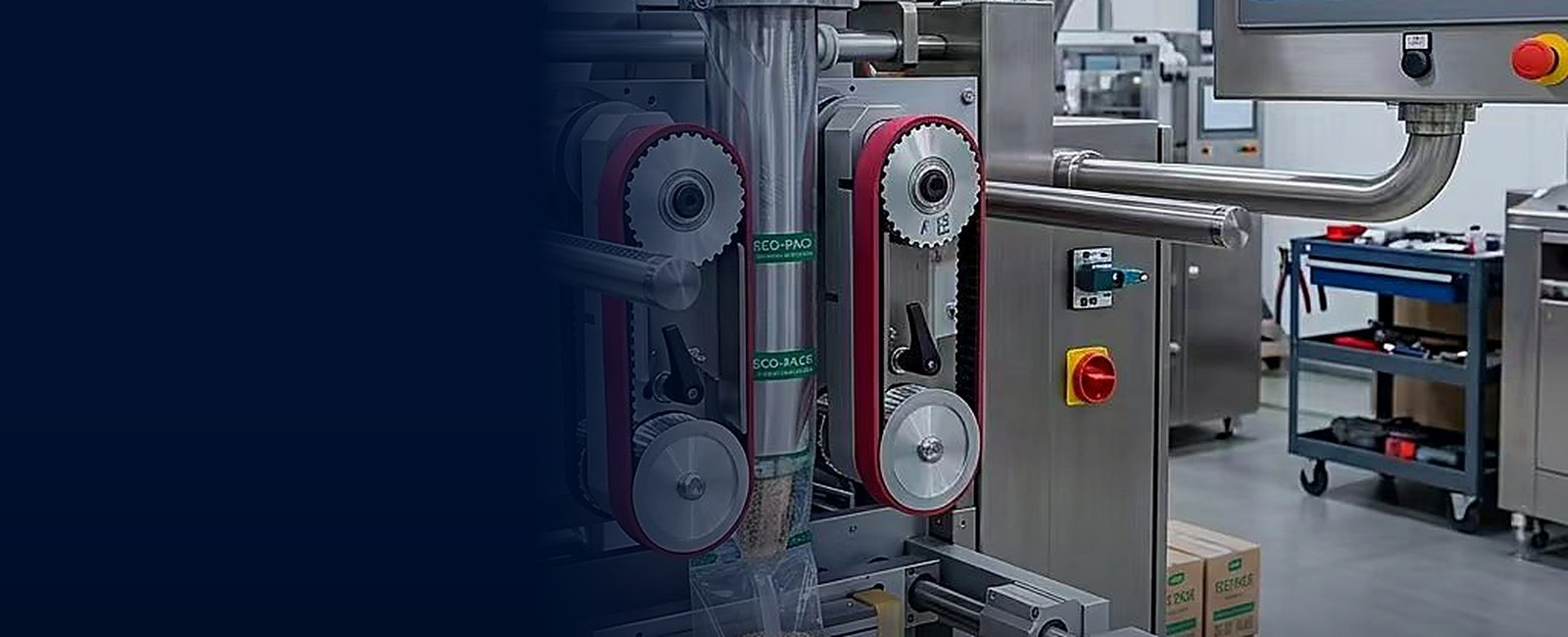
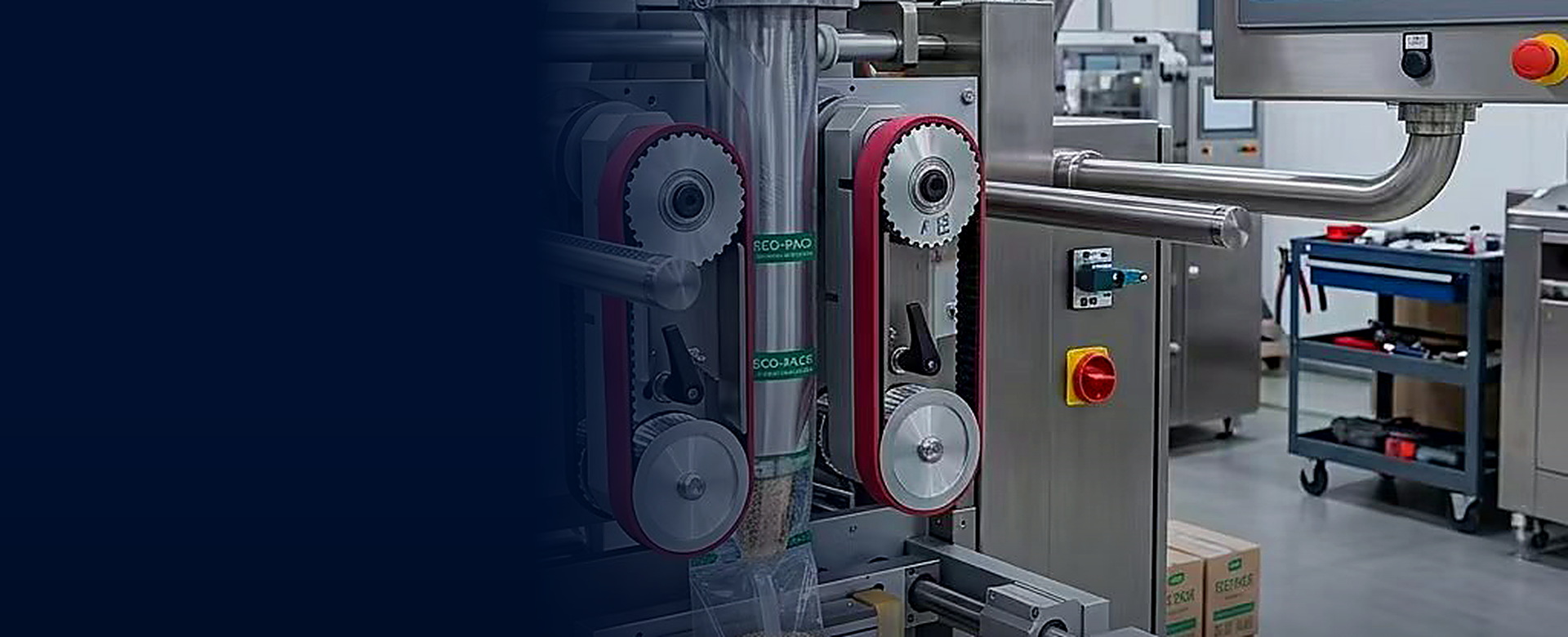
The most misunderstood element is the pull belt. On most machines it is a flat or coated belt running against the film, not a toothed belt, and its job is friction, not indexing. But the pull belt and the film feed belt share one loop: if the pull belt slips by one percent while the feed belt indexes accurately, the bag grows longer on every cycle and the operator compensates with tension until the film wrinkles at the jaw. The right fix is a coated belt with a stable, high-friction surface and a cord that will not creep — not a tighter tension setting.
Heat-Resistant Timing Belts for Vertical Form Fill Seal Sealers
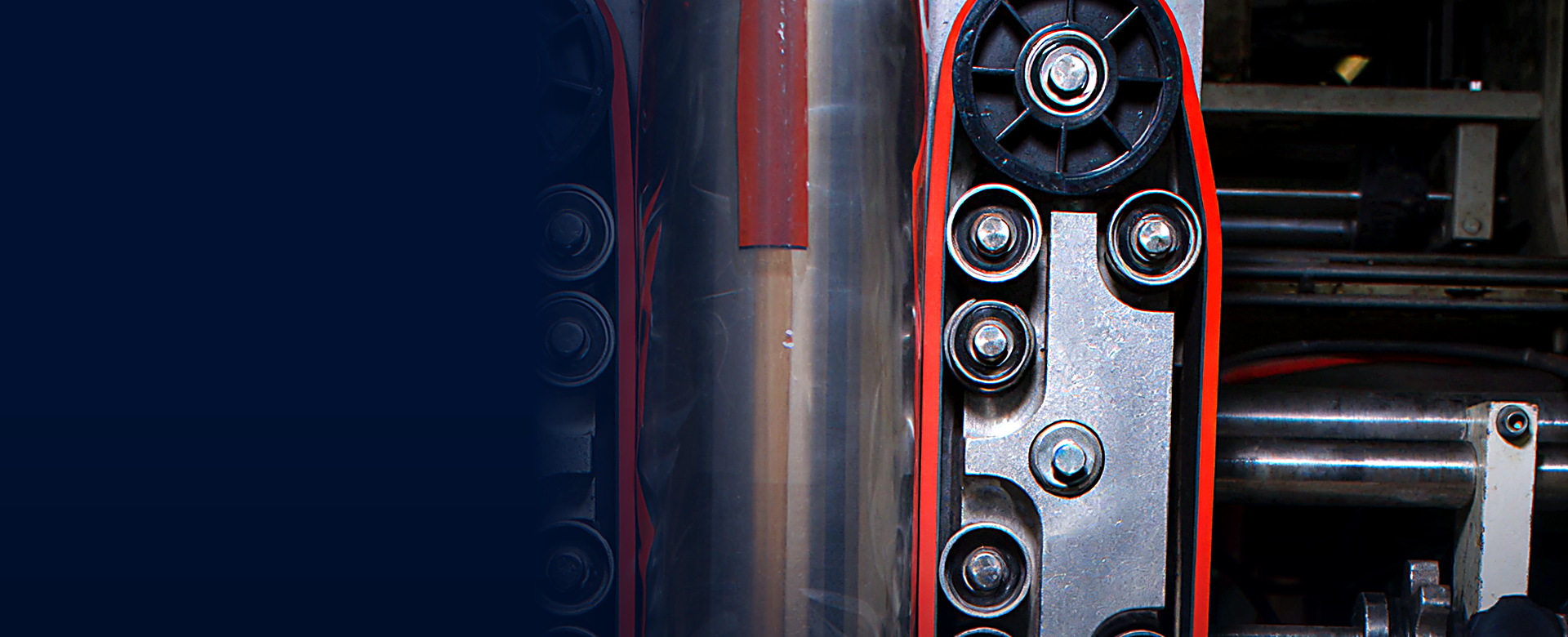
Sealing jaws are the hottest place on the machine. Even when the belt never touches the jaw, it lives in a zone radiating 180-220°C, and standard neoprene or PU compounds harden and crack within weeks. A heat-resistant silicone timing belt keeps its elasticity up to its service ceiling and does not embrittle the way chloroprene does, which is why silicone is the default for the jaw drive and for any belt passing within a few centimetres of the seal bar.
Two caveats worth putting on the drawing. First, silicone has lower tensile strength than rubber, so a silicone jaw belt needs a stronger cord and a slightly larger pulley diameter than the rubber belt it replaces — specify the cord, not just the compound. Second, the heat is one-sided: a silicone belt on a hot carriage also needs a back-side that tolerates the same temperature, or the fabric backing becomes the weak link. For a slow-motion comparison of silicone against rubber in hot, oily machine areas, see our silicone vs rubber analysis.
Custom Timing Belts for VFFS Manufacturers: Profiles, Backings and Foam Pads
Off-the-shelf custom timing belts sounds like a contradiction, but equipment manufacturers rarely get to choose standard sizes. Frame geometry is fixed by the machine design, film widths vary by product, and every brand has its own centre distances. That means nearly every belt on a VFFS machine is a custom length, and many are custom in profile as well.
- Profile and pitch. T5, T10 and AT10 dominate European-style baggers, HTD 3M and 5M appear on heavier North American frames, and GT2/GT3 shows up on servo-indexed film feeds. The profile has to match the installed pulleys exactly — see our tooth profile and pitch guide before converting.
- Widths. Pull belts often run 25-50 mm wide to spread the grip across the film; jaw drive belts are usually 10-25 mm. Custom widths are cut from moulded sleeves, so there is no tooling penalty.
- Backings. Rubber coating for grip, sponge and PU foam for gentle pouch contact, silicone for heat, and bare fabric for sliding guides.
- Cleats and flights. Pouch discharge belts need cleats at fixed pitch to time the transfer; the cleat spacing is cut to your control cycle, not to a catalogue number.
The other half of the specification is the joint. VFFS belts are usually endless: either moulded endless in the exact length, or cut from open stock and vulcanized into a loop. Vulcanized joints handle long lengths and fast delivery, while moulded endless belts hold the tightest length tolerance — which matters most on the film feed loop, where a 0.5 mm length error shows up as bag-length drift at 120 pouches per minute. Our endless vs open-ended comparison explains the tolerance difference.

Silicone and Sponge-Coated Belt Options for Gentle Film Handling
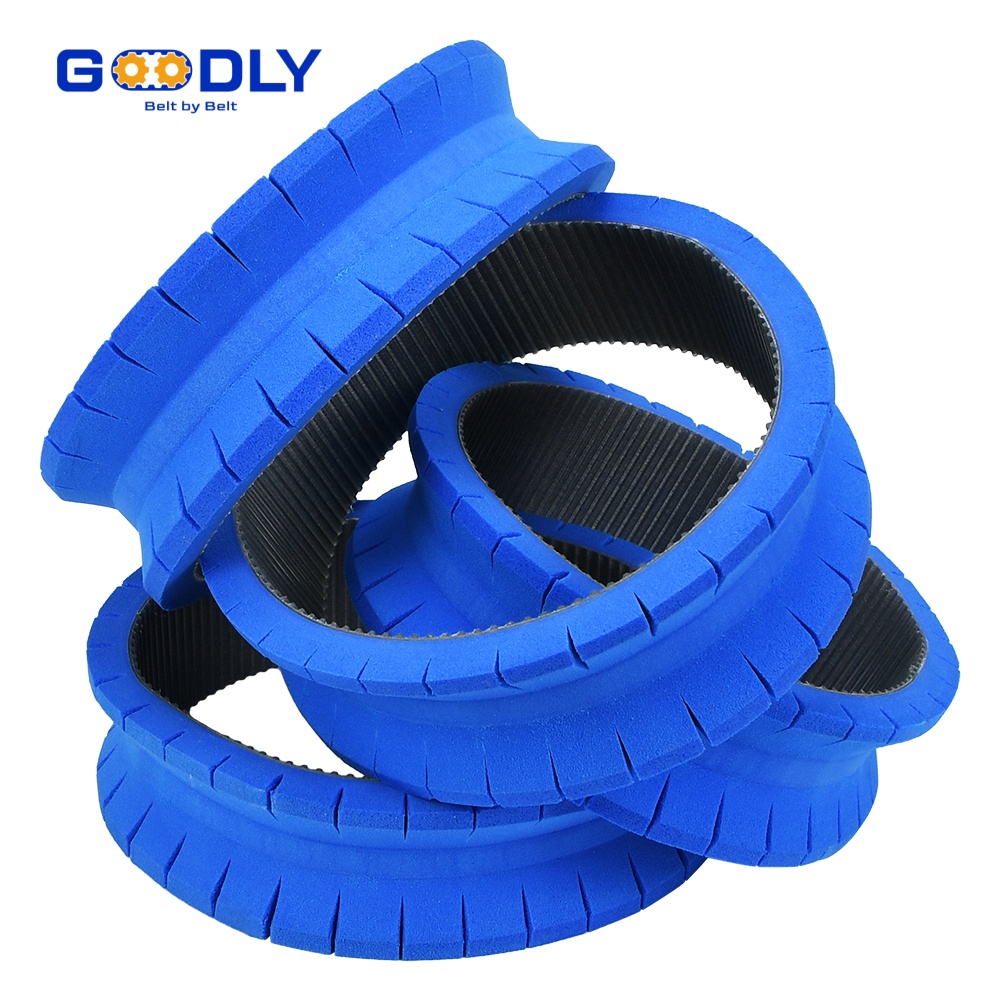
Film is a fragile material pretending to be a strong one. Metallised OPP scratches, printed laminate scuffs, and thin PE stretches if the belt grips it too hard on one side. A sponge timing belt solves this by replacing hard friction with compliant contact: the foam compresses around the film rather than cutting into it, and the grip is spread across the full belt width.
| Backing | Shore / density | Grip | Best VFFS duty |
|---|---|---|---|
| Silicone rubber coating | 40-60 Shore A | High, non-marking | Sealing jaw drive, hot zones, food-contact film |
| Orange / blue sponge | Medium density, closed or open cell | Medium, compliant | Printed film pull belts, pouch transfer |
| PU foam | Low to medium density | Low-medium, very gentle | Thin film, metallised wrap, cosmetic packaging |
| Bare rubber coating | 60-70 Shore A | Very high | Heavy laminate, high-speed pull with slip risk |
Two practical rules come out of that table. Match the backing to the film, not to the machine brand — the same bagger running metallised film and running 120-micron laminate needs different pull belt surfaces. And keep a spare set of pull belts at the same width as the widest film you run: a belt that is slightly narrow leaves two bright untensioned strips at the film edge, and that is where wrinkles start. Our sponge coated belt solution page covers the foam density options in more detail.
Matching OEM Specifications: Drop-In Timing Belt Replacements for VFFS Lines
When a machine builder needs a second source, the question is never “can you make a belt this size” — it is “will it drop in without touching the machine”. Four numbers decide that, and all four should appear on the drawing you send:
- Pitch length, measured on the pitch line, not the outside of the belt.
- Tooth profile and pitch, with the pulley part number if the machine is a legacy model.
- Width and thickness, including coating thickness — a 2 mm coating changes the pulley clearance.
- Cord type, because glass, Kevlar and steel give different stretch and different minimum pulley diameters.

Send a worn sample if the drawing is missing. Reverse-engineering from a used belt is routine: the profile can be measured, the pitch length counted, and the cord identified from a cut section. GOODLY returns a specification sheet for confirmation within 48 hours, which is faster than most OEMs can pull a drawing from their own archive. For the wider picture of what packaging machines demand, our packaging machinery application guide covers cartoners, wrappers and case packers as well.
Partner with GOODLY: Custom VFFS Timing Belt Development for Equipment Makers
GOODLY makes belts for equipment manufacturers rather than for end users, which changes the conversation. Instead of quoting a part number, we work from the machine drawing, agree the construction, run a first article on your machine, and then hold that construction stable for the production life of the model.
48 h specification
Drawing or sample in, confirmed belt specification with profile, cord and coating out.
3-5 day samples
Vulcanized and coated constructions ship in 3-5 working days for line trials.
Coating menu
Silicone, rubber, sponge and PU foam backings, plus cleats, guides and punched features.
Repeatable batches
Frozen process parameters after first article, so belt 1,000 matches belt 1.
Food and pharma packaging projects can be supplied with FDA-compliant silicone and rubber compounds, and every loop is pitch-checked before packing. Start with the VFFS equipment manufacturer solution page or the broader packaging industry belt range, then send us a drawing.
Is the pull belt on a VFFS machine a timing belt or a flat belt?
It depends on the machine. Many VFFS designs use a coated flat belt for the film pull, with a separate timing belt indexing the film feed. Some newer designs use a single timing belt with a high-friction coating for both. Check whether the belt wraps a toothed pulley before ordering a replacement.
What belt material handles sealing jaw heat best?
Silicone is the usual choice for jaw drives and any belt running within a few centimetres of the seal bar. It resists 180-220°C radiant heat without embrittling. Pair it with a heat-tolerant backing and a glass or Kevlar cord, since silicone alone has lower tensile strength than rubber.
Can you make custom widths for narrow film?
Yes. Custom widths are cut from moulded sleeves, so narrow pull belts for small pouches carry no tooling penalty. Send the film width and the machine frame dimension and we will confirm the belt width that keeps the grip even across the film.
How do I stop bag length from drifting on a high-speed line?
Usually by fixing the film feed loop, not the tension. Specify pitch length on the pitch line, use a low-creep cord, and keep the pull belt friction stable. If the pull belt glazes, the operator compensates with tension and the film wrinkles at the jaw.
Specifying Belts for a VFFS or Pouch Machine?
Send GOODLY the machine drawing, the film specification or a worn sample. We confirm profile, cord and coating within 48 hours and ship trial belts in 3-5 days. Every loop is pitch-checked, and the construction stays frozen across production batches.
Send Your VFFS Belt Drawing