Top Rubber Timing Belt Manufacturers and Suppliers for Industrial Applications (2026)
- Share
- publisher
- GOODLY Belts
- Issue Time
- Nov 27,2026
Summary
A buyer's comparison of rubber timing belt manufacturers and suppliers in 2026: which supplier types exist, how their quality, range and lead times actually differ, the red flags that predict failures, a validation sequence with a full specification table, and how GOODLY supplies OEMs and distributors factory direct.
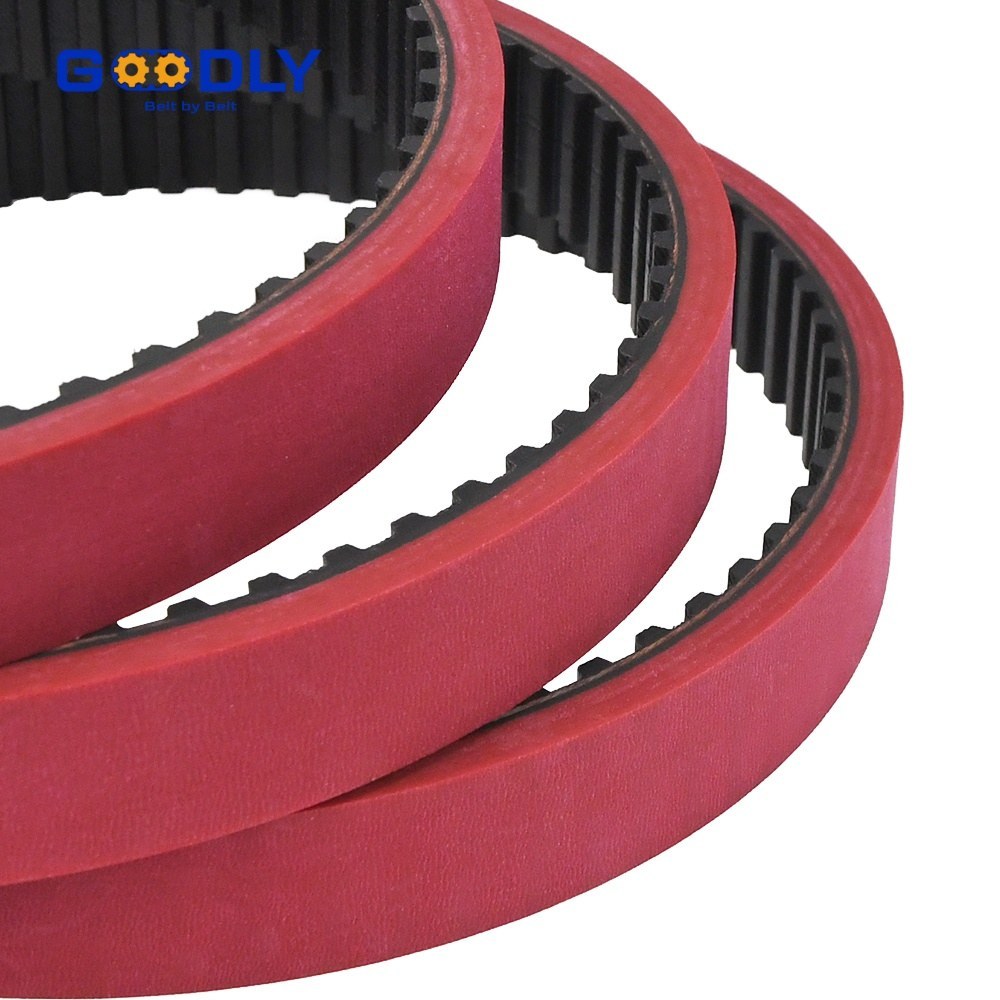
Quick answer
The strongest rubber timing belt manufacturers combine in-house rubber compounding, controlled vulcanizing and measured pitch accuracy — not just a large catalogue. For industrial OEM work, shortlist three to five factories that mold their own belts, publish tolerances and accept custom profiles, then approve a sample batch before committing to volume.
In this article
Searching for rubber timing belt manufacturers returns global belting groups, specialist Asian factories, machining shops and trading companies — and their quotes can differ by 300% for what looks like the same belt. That gap is not salesmanship. A rubber timing belt is a stack of decisions: compound, cord, tooth geometry, cure method and secondary machining, and each one moves cost, service life and noise. This guide compares the supplier types serving industrial buyers in 2026, sets out the numbers worth comparing them on, and gives you a validation sequence that filters weak suppliers before a purchase order instead of after a line stops.
Rubber Timing Belt Manufacturers: Who Makes the World’s Best Belts?
There is no single ranking that answers this, because “best” depends on which requirement is hardest in your machine. A plant replacing a catalogue belt from a local distributor is optimising for availability. A machine builder designing a new packaging station is optimising for a custom construction that holds timing over 20,000 hours. Those two buyers should shortlist from completely different pools of rubber timing belt manufacturers, and comparing them on price alone is how projects go wrong.
In practice, five supplier types cover the industrial market. The table below is the fastest way to see which of them can actually serve your case before you spend time on RFQs.
| Supplier type | Core strength | Typical range | Best fit | Risk to manage |
|---|---|---|---|---|
| Global belting groups | Brand recognition, global stock, wide catalogue | Hundreds of profiles | MRO replacement where a brand spec is mandated | Long custom lead times, minimum order values, thin engineering contact |
| Specialist OEM factories in Asia | Own compounding, molding or vulcanizing, in-house tooling | 50–200 profiles plus custom | Machine builders needing a matched construction | Must separate real factories from trading companies |
| Coated and machined belt specialists | Backings, cleats, grinding, perforating, splicing | Focused range, deep capability | Packaging, food, pharma and logistics stations | Narrower commodity range, so plan a second source |
| Trading companies and agents | Fast quotes, mixed containers, many factories | Everything on paper | Small mixed orders and one-off buys | No process ownership, unclear origin, weak corrective action |
| Regional distributors | Local stock, cut-and-splice service | Brand belts only | Urgent breakdown replacement | Price premium, no construction changes |
How the five supplier types compare for industrial rubber timing belt buyers in 2026.
The middle column matters more than it looks. Only two of these groups can change a compound or cut a new mold, which means only two can solve a problem that is not already solved in a catalogue. For buyers specifying a vulcanized timing belt for high torque or a long centre distance, the pool narrows to those two — and the next question becomes how to tell them apart.
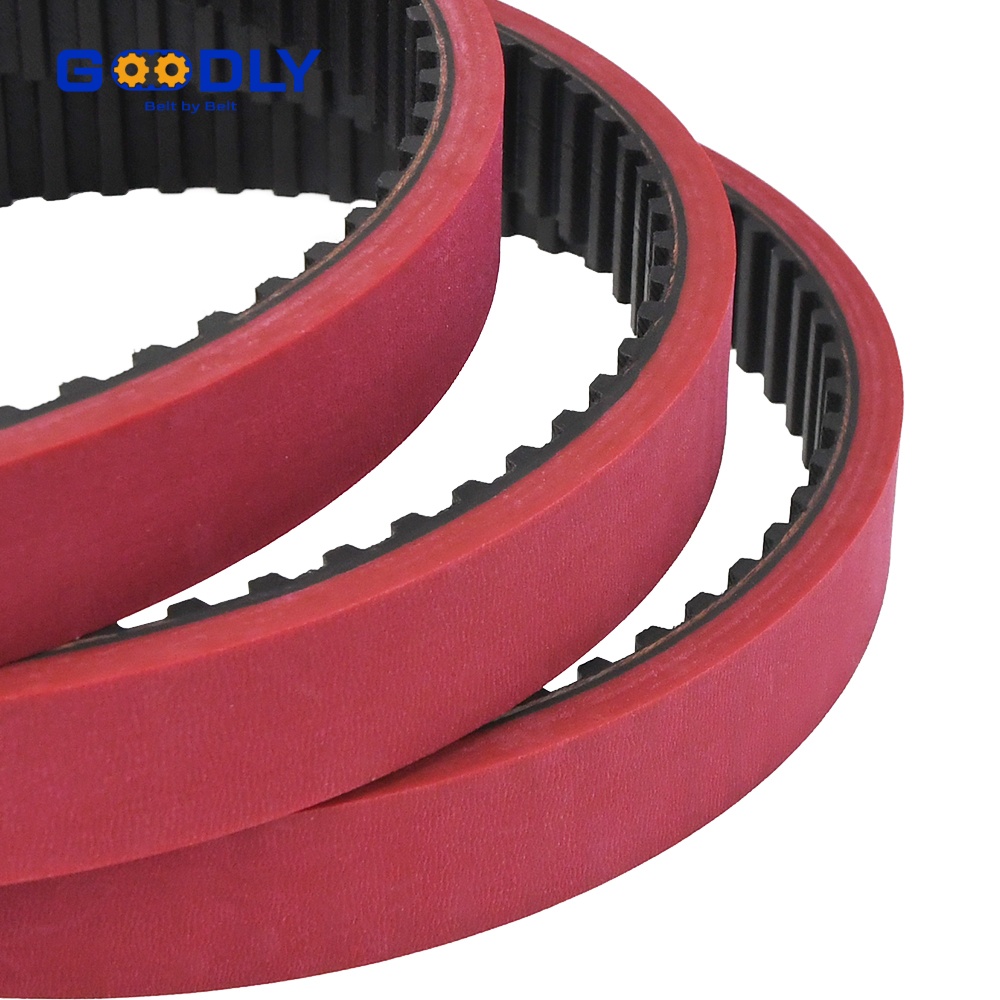
Comparing Rubber Timing Belt Suppliers: Quality, Range and Lead Times
Once a shortlist exists, compare it on the same six numbers. Ask every candidate for these in writing; the answers separate them faster than any brochure:
| Comparison point | Distributor | Trading company | OEM factory |
|---|---|---|---|
| Minimum order | 1 piece from stock | Often 100–500 pcs blended | 50–100 pcs per size for standard, project-based for custom |
| Custom tooth profile or pitch | Not possible | Relayed to a third party | In-house mold and process change |
| Sample lead time | Same week | 2–3 weeks | 3–7 days for existing tooling |
| Production lead time | From stock | 20–35 days | 15–25 days, scheduled with your forecast |
| Documentation | Brand datasheet | Generic certificate | Batch measurement record against your drawing |
| Engineering support | Catalogue selection | Order chasing | Direct contact with the process engineer |
Six comparison points that predict how a rubber timing belt supplier will behave after the first order.
The same six points hold whether you are buying catalogue sizes or custom timing belts built to a drawing — only the tolerance and tooling answers change. Lead time deserves one extra question too: what happens when it slips? A factory that owns its molding schedule can tell you which line your order sits on and what would move it. A trader can only forward an apology. Ask both, and weigh the answer accordingly.
Rubber Timing Belt Manufacturers in Asia: China, Japan and Taiwan Options
Asia supplies most of the world’s industrial rubber timing belts, but the three main origins play different roles. Japanese manufacturers set the benchmark for consistency and premium pricing, with long qualification cycles and limited willingness to change a construction. Taiwan sits between Japan and the mainland on both precision and price, and is strong where small volumes of well-controlled belts are needed. Chinese factories now cover the widest span: from commodity belts that compete purely on price to specialized plants running their own compounding, ring molds and vulcanizing lines with measured pitch control — the segment most OEM projects end up using. The verification path for this last group is set out in our China timing belt manufacturer sourcing guide.
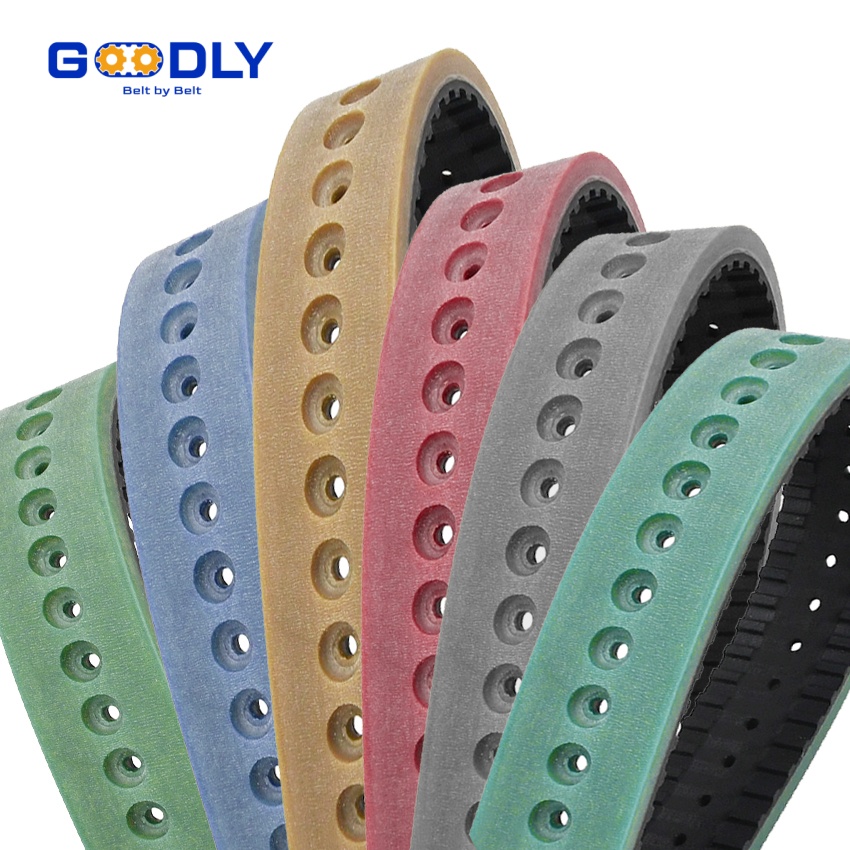
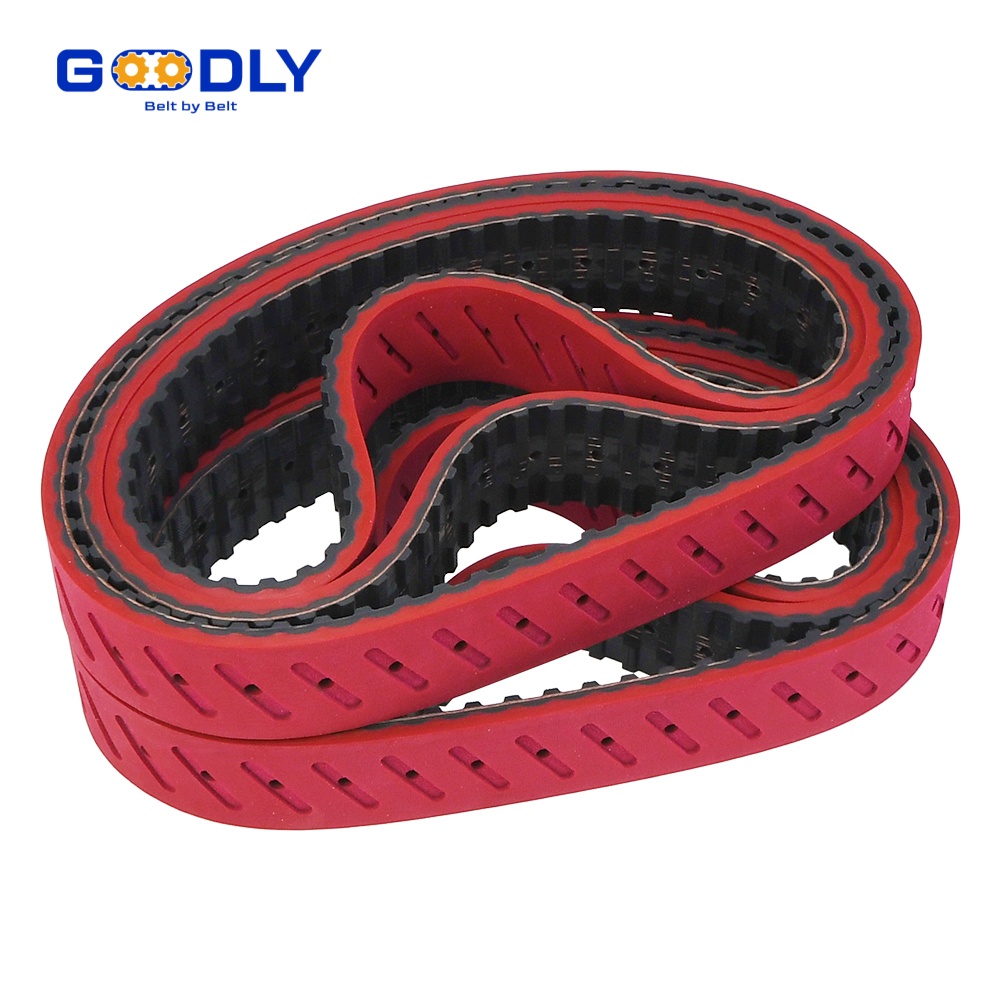
Where a belt has to grip, guide or protect the product as well as drive it, the construction matters more than the origin. Coated and machined variants — rubber-backed, cleated or perforated — come from a narrower set of suppliers, and the options are documented in our customized rubber coated belt solution.
Red Flags When Choosing Rubber Timing Belt Suppliers
Most supplier failures are visible months before delivery. These four signals appear in quotations and email threads, long before anything is manufactured:
Spec sheet without tolerances
A drawing with a profile and a length but no pitch, thickness or length tolerance has not been specified — it has been described. Without tolerances there is nothing to measure against and no basis for a claim.
Certificates without measurements
A compliance certificate that arrives without the batch values behind it tells you a process exists, not that it ran on your order. Ask for the recorded numbers for the batch you are buying.
No answer on compound
If nobody can name the polymer, hardness and cord in your belt, no one can predict its life in oil, heat or washdown. That silence usually continues after the sale.
A price that ignores construction
When a quote is far below the others, ask which element changed: compound grade, cord, cure method or inspection. If the answer is “nothing”, the belt is not the belt you specified.
One more test costs nothing: ask why a belt from a competitor failed in a specific way. A real manufacturer answers with adhesion, cure depth or misalignment and proposes a fix. A reseller answers with a discount. How those tests are actually run in a plant is covered in our timing belt quality control guide, and the wider market picture is in our review of the top 10 timing belt manufacturers.
How to Validate Rubber Timing Belt Quality Before Ordering
Validation is a sequence, and each step is cheap compared with the failure it prevents. Run all four before you release volume:
1. Review the drawing, not the sample. Confirm profile, pitch, length, width, thickness, backing and marking, each with a tolerance. A sample that fits but has no agreed tolerance cannot be repeated.
2. Measure the sample batch. Check pitch over 10 teeth, overall length, thickness and width on every piece in the sample lot, and ask for the same record with production. Measurement discipline is the clearest difference between a factory and a reseller.
3. Run it under load. Fit the belt on the real drive at real speed and temperature for at least 48 hours. Watch for tracking drift, tooth noise and edge wear, which show up long before a tooth shears.
4. Fix the paperwork. Agree the inspection standard, the batch traceability format and the corrective-action route in writing. This is what protects you eighteen months later.
The specification table below is the reference we work from for industrial rubber timing belts. Treat the middle column as a starting requirement and the right column as what should be confirmed in writing for your drawing:
| Property | Typical industrial requirement | What to confirm in writing |
|---|---|---|
| Compound hardness | 70–85 Shore A for drive belts | Measured hardness range and compound code per batch |
| Pitch tolerance | ±0.1 mm over 10 pitches | Inspection method and gauge used at final check |
| Length tolerance | ±0.5 mm per metre, tighter on short belts | Measurement temperature and pre-tension during check |
| Thickness tolerance | ±0.2 mm | Whether the backing or coating is included in the callout |
| Continuous temperature | −20 °C to +80 °C for standard NBR | Compound-specific limit if the station runs hotter |
| Tensile member | Glass cord standard, aramid for high torque | Cord type, and whether it is specified on the drawing |
| Tooth shear | No root cracking after the agreed run-in test | Test duration, load and pass criteria |
| Minimum pulley diameter | Set by profile and cord, not by habit | Confirmed back-bend radius for your drive layout |
Rubber timing belt specification reference: typical industrial requirements and the values that must be confirmed per drawing.
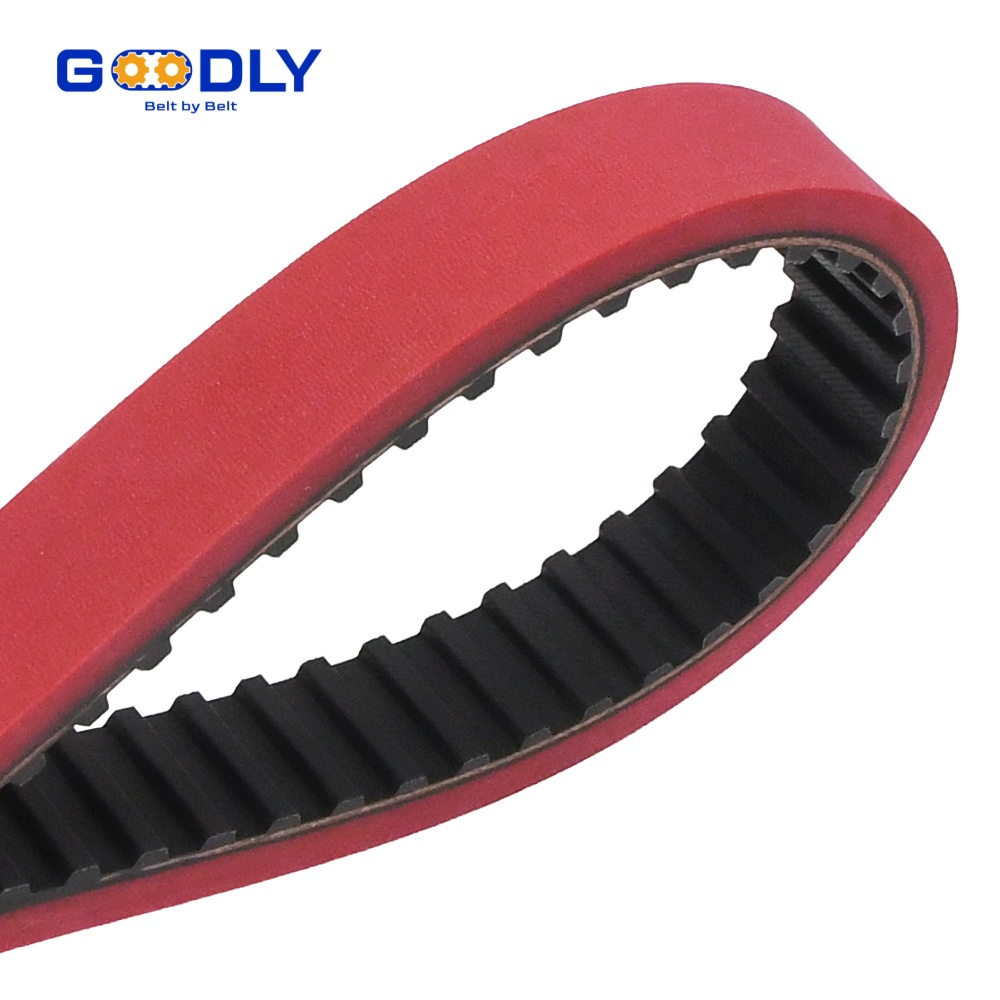
GOODLY: Rubber Timing Belt Factory Direct for OEMs and Distributors
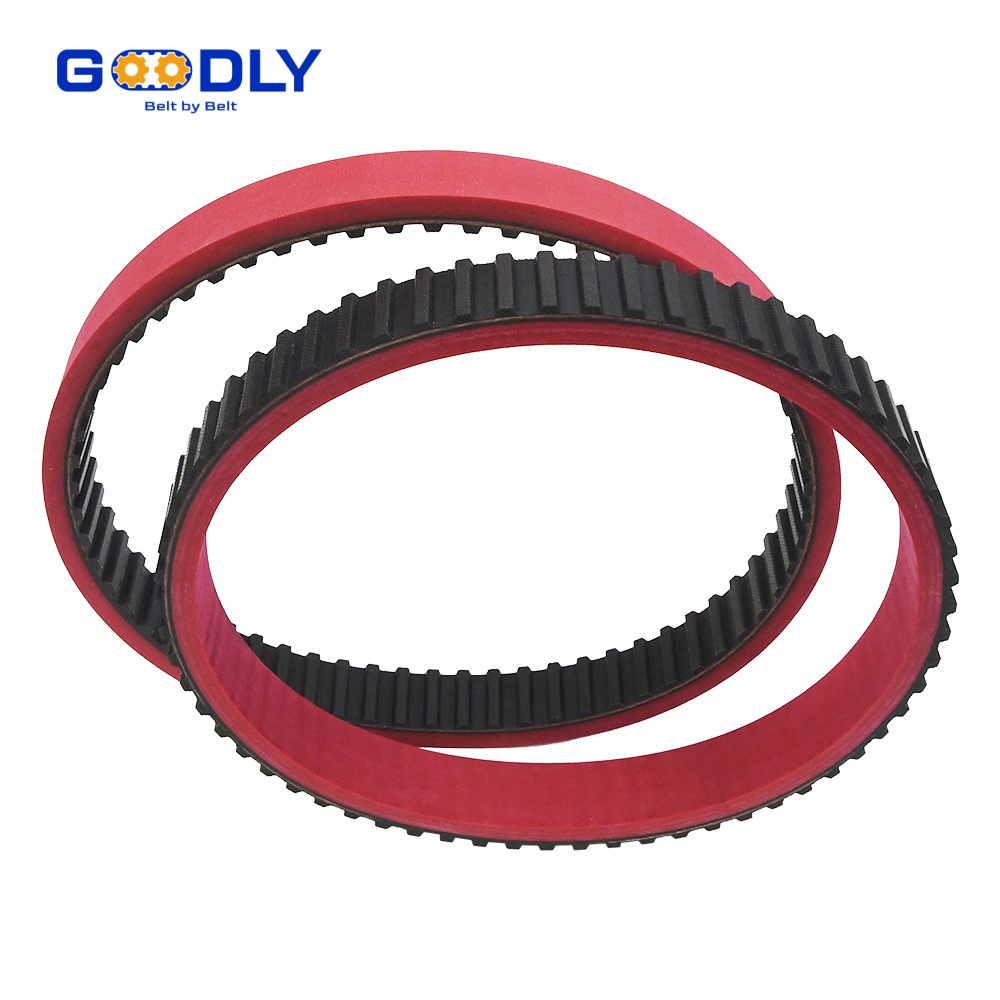
GOODLY has manufactured industrial belts in Guangzhou since 2011, with mold design, rubber compounding, vulcanizing, machining and testing under one roof. That vertical range is what makes custom work practical: a rubber timing belt can be molded in a non-catalogue profile, ground to a thickness, backed with rubber or foam, perforated, cleated or slit to width without leaving the building. Nine utility model patents cover constructions such as the vacuum film stretching belt, tooling runs against ISO 9001:2015 procedures, and every batch is dimensionally checked before dispatch.
For OEM and distributor buyers the working model is simple: send a drawing or a worn sample, get a construction proposal with tolerances, approve a sample batch, then run volume against a frozen specification. Tooling ownership, NDAs and repeat-order control are covered in the OEM and ODM timing belt manufacturing guide, and the secondary operations in our special machining overview. If you want to see the process before you send an RFQ, start with inside a timing belt factory.
Send us the drawing, get a construction proposal
Tell us the profile, length, load and environment. We reply with a recommended construction, tolerances and a sample plan — usually within one working day.
Frequently Asked Questions
Who are the largest rubber timing belt manufacturers in the world?
The largest suppliers by volume are multinational belting groups with broad catalogues and global distribution, followed by specialist factories in Asia that focus on synchronous drives. Size matters for availability, but for custom constructions the deciding factor is whether the plant owns its compounding, tooling and inspection — not its revenue.
Are Chinese rubber timing belt manufacturers reliable?
Yes, when you qualify them like any other supplier. Ask for the manufacturing license scope, a video or on-site audit of the molding and inspection area, batch measurement records and a sample lot you can test under load. The factories that pass all four are dependable partners; the ones that deflect the audit are usually trading companies.
What is the minimum order for a custom rubber timing belt?
For an existing mold, most factories start at 50–100 pieces per size. Custom timing belts in a new tooth profile or an unusual width involve tooling, so the first order is usually quoted as a project with a sample batch, then volume against the frozen specification.
How long does a custom rubber timing belt take to produce?
With tooling available, samples typically ship in 3–7 days and production runs in 15–25 days depending on quantity and secondary operations. A new mold adds 10–20 days for design, cutting and first-article approval.
Can you match a belt we currently buy from another brand?
In most cases yes. Send the belt or a drawing with profile, pitch, length, width and thickness, plus the load and environment, and we will confirm the equivalent construction and any tolerance differences before quoting.
Still comparing suppliers? Send your specification to our engineering team through the GOODLY contact page and we will tell you honestly whether a custom construction is needed — or whether a catalogue belt will do the job. More background on materials and selection is in the rubber timing belt buyer guide.