What factors should be considered when selecting a PU timing belt?
- Share
- Issue Time
- Dec 29,2025
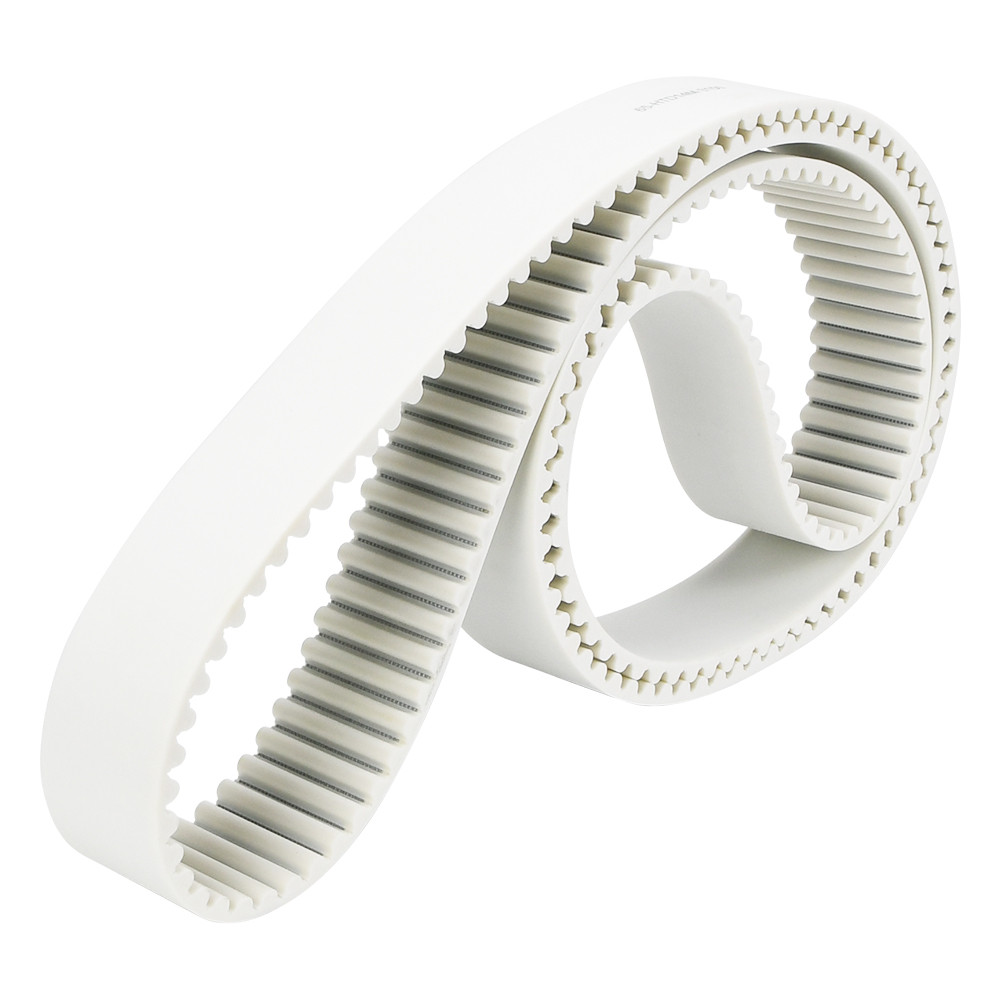
Selecting a suitable PU timing belt requires comprehensive consideration of transmission parameters, application environment and structural matching. The specific key factors are as follows:
Transmission performance requirements
First, confirm the load capacity: PU timing belts are suitable for light-to-medium load transmission (generally the tensile strength is 100–500 N/mm). For heavy-load scenarios, it is necessary to select reinforced PU timing belts with steel cord or aramid fiber cores. Second, check the transmission speed and precision: high-speed (above 5 m/s) or high-precision positioning applications require PU timing belts with high-precision tooth profiles (such as HTD, GT, T series) to ensure stable operation without jumping teeth.
Operating environment conditions
Temperature: Choose standard PU timing belts for normal temperature environments (-30°C to 80°C); for high-temperature environments above 80°C, select high-temperature resistant PU timing belts modified with special additives.
Chemical contact: If the belt is exposed to oil, solvents or corrosive gases, confirm that the selected PU material has corresponding resistance; avoid using ordinary PU timing belts in strong acid and alkali environments.
Dust and debris: In dusty environments, choose closed PU timing belts or add protective covers to prevent debris from entering the meshing area of the belt and pulley, causing tooth wear or jumping teeth.
Structural and specification matching
Tooth profile type: Match the tooth profile of the timing pulley. Common tooth profile types include T (trapezoidal tooth), HTD (circular arc tooth) and GT (curved tooth). HTD and GT series have higher load capacity and transmission precision, and are suitable for high-performance equipment; T series are economical and practical, and are suitable for general transmission scenarios.
Length and width: Calculate the required belt length according to the center distance between the driving and driven pulleys; the belt width should be determined according to the load—wider belts can bear larger loads, but they will increase the overall weight and cost of the transmission system.
Core material: Choose glass fiber core for general precision transmission; choose steel cord or aramid fiber core for high-tensile, low-elongation requirements to prevent belt elongation and ensure transmission accuracy.